Axé, ancestry, and activism—this is the Brazil that will take over Miami this month. Through powerful solo showcases and immersive group exhibitions, the three Brazilian galleries debuting at Art Basel spotlight narratives from Indigenous peoples and historically oppressed social groups to expose various forms of aggression while presenting art as a process of healing.
The Rio de Janeiro-based gallery Portas Vilaseca (@portasvilaseca) has chosen to present a "forest" of sculptures by Nádia Taquary and Ayrson Heráclito. In light of Brazil's violent history of slavery, the works evoke deities of Candomblé to reinforce narratives of resistance and inspire transformation through the purification and reorganization of energies. Sounds of nature and original compositions by Tiganá Santana fill the space, guiding visitors into a state of trance and connection with invisible realms. "I believe this is a project worthy of our debut at Art Basel Miami," celebrates gallerist Jaime Portas Vilaseca.
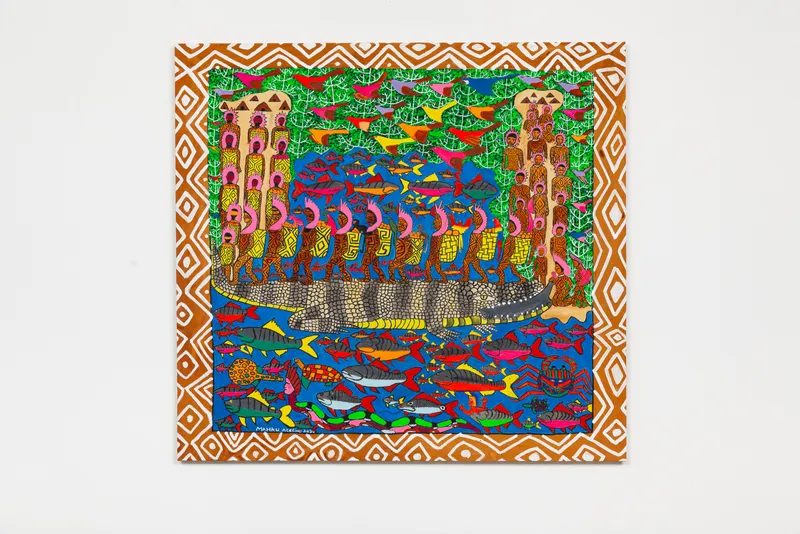
Colonial brutality is also countered by MAHKU (Huni Kuin Artists Movement), whose paintings are on view at Carmo Johnson Projects (@carmojohnsonprojects), a gallery specializing in contemporary Indigenous art. Their canvases narrate experiences in the Amazon rainforest and mythologies from Huni Kuin cosmology. Proceeds from the collective's art sales are used to secure basic rights for the Huni Kuin people—MAHKU has already purchased 20 hectares, reclaiming part of their lost territory.
Micro and macro-political struggles serve as starting points for the work of Randolpho Lamonier, whose textile pieces are showcased by São Paulo-based Verve gallery (@vervegaleria). "We chose Lamonier's work for our entry at Basel because it feels incredibly timely," reflects Ian Duarte, Verve's co-owner. "His work sparks reflections on violence against the LGBTQIAPN+ community," he adds. At the fair, Lamonier presents the Bittersweet Haiku series, where he combines the traditional Japanese haiku with Dutch still-life imagery using textiles and prints, as well as his celebrated Prophecies, composed of sewn and embroidered fabric banners that convey political messages, predictions, and demands for the future.
